
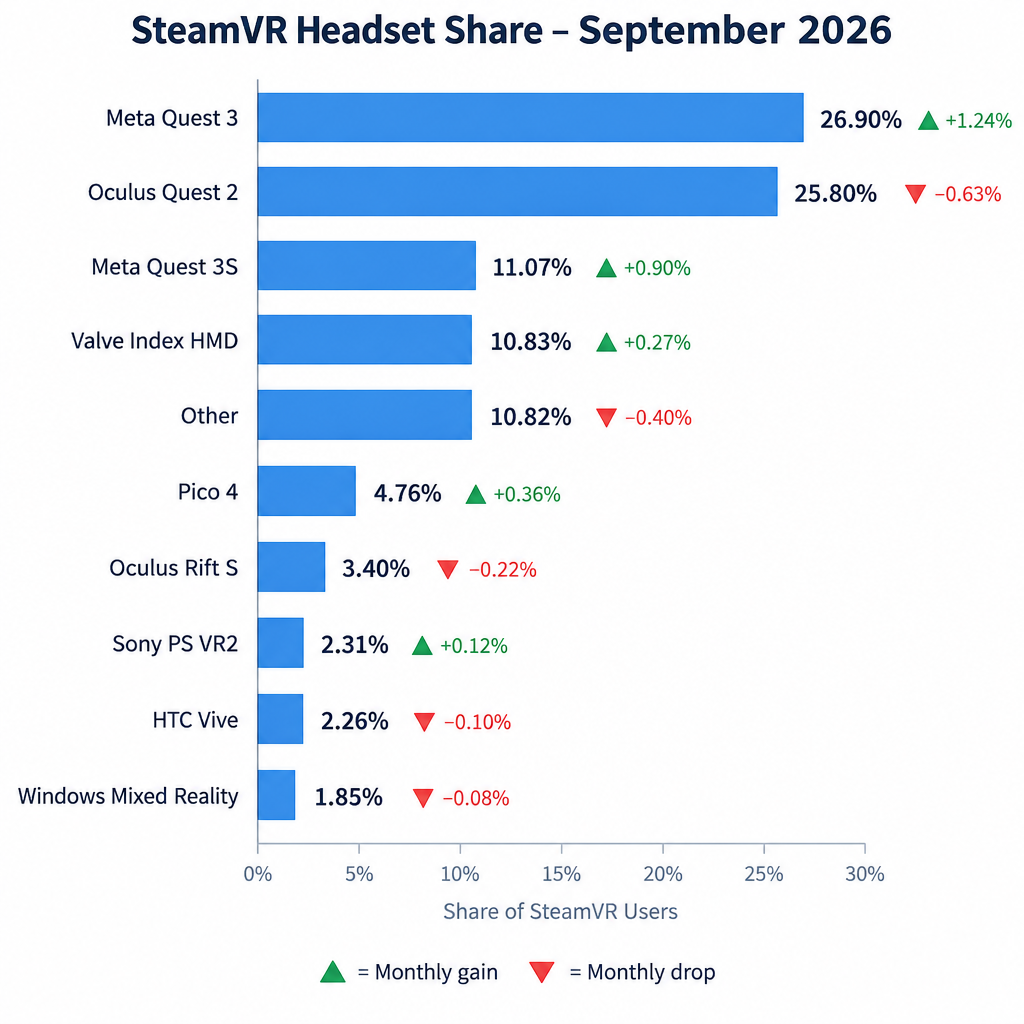
Meta Quest 3 is the most used VR headset on Steam in the September 2026 Steam Hardware & Software Survey. It holds 26.90% of SteamVR headsets after a 0.89-point gain, which moves it back ahead of the Oculus Quest 2. The biggest mover of the month is the Quest 2 itself, which fell 1.17 points to 25.80%, while the “Other” bucket posted the largest gain at +0.95 points.
The September 2026 VR headset table
Valve’s VR Headsets section does not measure how many Steam users own VR. It measures which headsets appear among the surveyed users who have one connected. Every figure below is a share of that smaller group, and the ten rows add up to exactly 100%.
| Rank | Headset | Share of SteamVR headsets (Sept 2026) | Change vs August 2026 (points) | Change vs March 2026 (points) |
|---|---|---|---|---|
| 1 | Meta Quest 3 | 26.90% | +0.89 | -0.76 |
| 2 | Oculus Quest 2 | 25.80% | -1.17 | +3.06 |
| 3 | Meta Quest 3S | 11.07% | -0.43 | -1.68 |
| 4 | Valve Index HMD | 10.83% | -0.24 | -2.09 |
| 5 | Other | 10.82% | +0.95 | +1.18 |
| 6 | Pico 4 | 4.76% | +0.28 | +1.43 |
| 7 | Oculus Rift S | 3.40% | +0.01 | -0.60 |
| 8 | Sony PS VR2 | 2.31% | +0.07 | +0.18 |
| 9 | HTC Vive | 2.26% | -0.13 | -0.41 |
| 10 | Windows Mixed Reality | 1.85% | -0.23 | -0.31 |
“Six months ago” means the March 2026 survey, so the third change column compares September directly against March. Figures come from the September 2026 survey page as pulled on October 21, 2026.
The headline: Quest 3 takes the top spot back from Quest 2
If you subtract this month’s changes from the September figures, you get the August 2026 picture. In August, Quest 2 held first place at 26.97% and Quest 3 sat behind it at 26.01%. That 0.96-point gap has now flipped into a 1.10-point lead for Quest 3, a combined swing of 2.06 points between the two headsets in a single month.
The reversal ranks as the month’s main story, but it needs context. Quest 3 has been the top Steam headset for long stretches since its October 2023 launch, and its September share is still 0.76 points below where it stood in March. The Quest 2, by contrast, gained 3.06 points over the same six months even after this month’s drop. The leadership change looks less like a fresh Quest 3 surge and more like Quest 2’s unusual spring and summer run losing some steam.
Neither result should be read in isolation. Two headsets separated by about a point can trade places on sampling noise alone, which is why the six-month column deserves as much attention as the monthly one.
Month over month: who moved between August and September 2026
Here is the August baseline reconstructed from Valve’s change figures, set against September. The derived August numbers also sum to exactly 100%, which is a useful sanity check on the data.
| Headset | August 2026 (derived) | September 2026 | Change (points) | Rank change |
|---|---|---|---|---|
| Meta Quest 3 | 26.01% | 26.90% | +0.89 | 2nd to 1st |
| Oculus Quest 2 | 26.97% | 25.80% | -1.17 | 1st to 2nd |
| Meta Quest 3S | 11.50% | 11.07% | -0.43 | Holds 3rd |
| Valve Index HMD | 11.07% | 10.83% | -0.24 | Holds 4th |
| Other | 9.87% | 10.82% | +0.95 | Holds 5th |
| Pico 4 | 4.48% | 4.76% | +0.28 | Holds 6th |
| Oculus Rift S | 3.39% | 3.40% | +0.01 | Holds 7th |
| Sony PS VR2 | 2.24% | 2.31% | +0.07 | 9th to 8th |
| HTC Vive | 2.39% | 2.26% | -0.13 | 8th to 9th |
| Windows Mixed Reality | 2.08% | 1.85% | -0.23 | Holds 10th |
Three things stand out once you lay the two months side by side.
Quest 2 posts the largest single drop
A 1.17-point fall is the biggest monthly move in the table. Because the Quest 2 is no longer sold new by Meta, it cannot gain share from new purchases. Its share rises or falls depending on how many existing owners keep using it with SteamVR and how the monthly sample happens to fall.
The “Other” bucket grows almost as fast as Quest 3
At +0.95 points, “Other” outpaced every named headset except Quest 3. Valve does not break this category down, so you cannot tell from the survey alone which devices drove the gain. What you can say is that headsets outside the named rows account for only about 1.49% of SteamVR users, far below the Valve Index, which is itself a named row at 10.83%.
PS VR2 edges past the original HTC Vive
The PS VR2 rose to 2.31% while the 2016 HTC Vive slid to 2.26%, so Sony’s headset now ranks eighth and the Vive ninth. The margin is just 0.05 points, which is well inside the range where the next survey could reverse it. The direction of travel matters more than the rank: PS VR2 has gained over six months and the Vive has lost ground.
The six-month view: Quest 2’s surge and the Index’s slide
The six-month column tells a cleaner story than the month-to-month numbers, because a single unusual sample has less influence. Reconstructing March 2026 from Valve’s figures gives this comparison.
| Headset | March 2026 (derived) | September 2026 | Change (points) | Relative change |
|---|---|---|---|---|
| Meta Quest 3 | 27.66% | 26.90% | -0.76 | -2.7% |
| Oculus Quest 2 | 22.74% | 25.80% | +3.06 | +13.5% |
| Meta Quest 3S | 12.75% | 11.07% | -1.68 | -13.2% |
| Valve Index HMD | 12.92% | 10.83% | -2.09 | -16.2% |
| Other | 9.64% | 10.82% | +1.18 | +12.2% |
| Pico 4 | 3.33% | 4.76% | +1.43 | +42.9% |
| Oculus Rift S | 4.00% | 3.40% | -0.60 | -15.0% |
| Sony PS VR2 | 2.13% | 2.31% | +0.18 | +8.5% |
| HTC Vive | 2.67% | 2.26% | -0.41 | -15.4% |
| Windows Mixed Reality | 2.16% | 1.85% | -0.31 | -14.4% |
Two rank changes happened inside that window. In March, the Valve Index (12.92%) still sat narrowly ahead of the Quest 3S (12.75%). By September the order had flipped, with the 3S at 11.07% and the Index at 10.83%. The Pico 4 also climbed past the Rift S: it trailed 3.33% to 4.00% in March and now leads 4.76% to 3.40%.
The Valve Index posted the largest six-month loss at 2.09 points, about a sixth of its March share. Pico 4 posted the largest relative gain, up roughly 43% from a small base. The Quest 3S, which you might expect to grow as Meta’s cheapest current headset, actually lost 1.68 points over the period.
Meta’s share barely moves; the shuffle happens inside its lineup
Grouping the headsets by maker shows how stable the overall picture is, even when individual rows swing.
| Maker / platform | March 2026 | August 2026 | September 2026 |
|---|---|---|---|
| Meta (Quest 3, Quest 2, Quest 3S, Rift S) | 67.15% | 67.87% | 67.17% |
| Valve (Index) | 12.92% | 11.07% | 10.83% |
| Other (unnamed) | 9.64% | 9.87% | 10.82% |
| Pico (Pico 4) | 3.33% | 4.48% | 4.76% |
| Sony (PS VR2) | 2.13% | 2.24% | 2.31% |
| HTC (original Vive) | 2.67% | 2.39% | 2.26% |
| Windows Mixed Reality (various) | 2.16% | 2.08% | 1.85% |
Meta’s four named headsets account for 67.17% of SteamVR users in September, almost exactly where they were in March. Over six months, the Quest 2 gained what the Quest 3, Quest 3S and Rift S lost between them. If you only track Meta’s overall share, you would conclude nothing happened. If you track the individual headsets, you see older hardware holding on longer than you might expect.
Valve’s own share is the clearest structural decline in the table. The Index lost about 2.1 points over six months, and no other Valve headset appears among the named rows.
What is driving the changes
The survey reports what people use. It does not explain why. The explanations below are grounded in verifiable changes to the headset market, and where the data cannot support a firm attribution, that is stated plainly.
Meta’s lineup and pricing set the baseline
Meta reshaped its range at Connect in September 2024. It launched the Quest 3S on October 15, 2024 at $299.99 for 128GB and $399.99 for 256GB, cut the 512GB Quest 3 from $649.99 to $499.99, and dropped the 128GB Quest 3. Meta also said it would stop selling the Quest 2 and Quest Pro once remaining stock ran out by the end of 2024.
That lineup explains the broad shape of the table. The Quest 3 at $499.99 is the premium standalone that many PC players buy specifically for streaming SteamVR games. The Quest 3S shares the Quest 3’s chipset but uses the same per-eye panel resolution and Fresnel lenses as the Quest 2, and it is often bought as a cheaper standalone console rather than a PC VR headset. That buyer profile helps explain why a headset that sells well at retail sits at only 11.07% on Steam.
The Quest 2 refuses to fade
The Quest 2 launched in October 2020 at $299 and became the best-selling VR headset of its generation. With no new units from Meta, its +3.06-point six-month gain cannot come from fresh retail sales. More plausible contributors include secondhand and gifted units, owners who keep an older headset for PC streaming after upgrading, and shifts in which Steam users the survey happens to sample.
That last point matters. The Steam survey has a long record of month-to-month swings in unrelated categories, such as language and regional mix, that reflect who answered rather than what changed in the market. A headset with a large installed base in price-sensitive regions can rise or fall several points without any change in real-world ownership. The September drop of 1.17 points is the same effect running the other way.
The Valve Index ages, and Steam Frame is waiting in the wings
The Valve Index launched in June 2019 with 1440×1600 LCD panels per eye and refresh rates up to 144Hz. It was the enthusiast benchmark for years, but it requires a powerful PC, base stations and a dedicated setup. A 16% relative decline over six months is consistent with long-time owners moving to newer headsets.
Valve announced its replacement, Steam Frame, in November 2025. Valve’s announced specifications include 2160×2160 LCD panels per eye, refresh rates from 72Hz to 144Hz, a Snapdragon 8 Gen 3 chip, 16GB of memory, eye tracking for what Valve calls foveated streaming, and an early 2026 shipping target. Steam Frame does not appear as a named row in the September 2026 table. Any share it holds in this survey is folded into “Other”, which means you cannot measure its uptake from these numbers yet.
It is tempting to credit Steam Frame for the +0.95-point jump in “Other”, but the data does not allow it. Other PC headsets, including the Bigscreen Beyond 2, Pimax models and various less common devices, also live in that bucket. The honest reading is that “Other” is growing and new hardware is a likely contributor, but Valve’s breakdown does not say which hardware.
Player tip
If you want to know what Valve would record about your setup, open the Steam client and choose Help, then System Information. It shows the hardware details the survey reads, though you cannot trigger a survey invitation yourself.
Pico 4 keeps climbing outside the United States
ByteDance’s Pico 4 launched in October 2022 in Europe and Asia, with 2160×2160 panels per eye, but it was never sold officially in the United States. Its six-month rise from 3.33% to 4.76% happened without any matching change to Meta’s lineup, so it likely reflects regional sampling, ongoing sales in markets where Pico competes directly with Quest, or both. Pico 4 owners who stream to PC rely on Pico’s own streaming software or third-party apps, and the survey does not separate those routes.
PS VR2 benefits from its PC adapter and a lower price
Sony released a PC adapter for PS VR2 on August 7, 2024 at $59.99, which made the headset work with SteamVR games on Windows. Sony then cut the headset’s US price from $549.99 to $399.99 in March 2025. On PC, the headset loses some of its PS5 features, including eye tracking and HDR, and you need a GPU with a DisplayPort output and a compatible Bluetooth connection.
That combination explains why PS VR2 grows slowly instead of quickly. It has a niche on Steam among PS5 owners who also game on PC, and the +0.18-point six-month gain fits that profile.
Windows Mixed Reality heads for the exit
Microsoft deprecated Windows Mixed Reality and removed it from Windows 11 version 24H2, released in October 2024. Owners of HP Reverb G2, Samsung Odyssey and other WMR headsets who update to 24H2 or later lose official support. A 1.85% share that falls 0.23 points in a month is the expected result, and community workarounds for keeping these headsets alive will not reverse the trend.
Older tethered headsets keep shrinking
The Rift S (May 2019, 1280×1440 per eye, discontinued in 2021) and the original HTC Vive (April 2016, 1080×1200 per eye) are both legacy devices. The Vive lost 0.41 points over six months and the Rift S lost 0.60. The Rift S held flat this month at +0.01, which shows how much noise can mask a long-term decline in any single reading.
The headsets in the table, side by side
The September 2026 list spans a decade of hardware. If you are trying to understand who is actually behind these percentages, the gap in display quality and connection method between the top and bottom rows is large.
| Headset | Release | Resolution per eye | Max refresh rate | How it connects to SteamVR |
|---|---|---|---|---|
| Meta Quest 3 | Oct 2023 | 2064×2208 | 120Hz | Link cable, Air Link, Steam Link, Virtual Desktop |
| Oculus Quest 2 | Oct 2020 | 1832×1920 | 120Hz | Link cable, Air Link, Steam Link, Virtual Desktop |
| Meta Quest 3S | Oct 2024 | 1832×1920 | 120Hz | Link cable, Air Link, Steam Link, Virtual Desktop |
| Valve Index | Jun 2019 | 1440×1600 | 144Hz | DisplayPort tether, base stations |
| Pico 4 | Oct 2022 | 2160×2160 | 90Hz | Pico streaming or third-party apps |
| Oculus Rift S | May 2019 | 1280×1440 | 80Hz | DisplayPort tether |
| Sony PS VR2 | Feb 2023 | 2000×2040 (OLED) | 120Hz | Sony PC adapter |
| HTC Vive | Apr 2016 | 1080×1200 | 90Hz | Tether, base stations |
| Windows Mixed Reality | Various | Varies by model | Varies | Tether, unsupported on Windows 11 24H2+ |
The pattern is clear. Roughly 68.5% of SteamVR users in September are on standalone headsets (Quest 3, Quest 2, Quest 3S and Pico 4) that stream from a PC, up from about 66.5% in March. The four legacy tethered headsets in the named rows, Index, Rift S, Vive and WMR, fell from about 21.8% to 18.3% over the same six months.
Valve released its own Steam Link app for Quest in November 2023, which made streaming SteamVR games to Quest headsets free and simple without Meta’s PC app as a middle layer. That release helped make “PC VR” mean “a standalone headset on Wi-Fi” for most players, and the September 2026 survey continues to reflect it.
Comfort check
Wireless PC VR over a congested Wi-Fi network adds latency and stutter that can trigger motion sickness fast. Use a dedicated Wi-Fi 6 or 6E router near your play space, or a cable, and stop at the first sign of nausea.
What the September 2026 numbers mean for you as a buyer
The survey is not a buying guide, but it does show you which hardware the PC VR ecosystem is built around. Here is how to read it if you are shopping for a headset in late 2026.
The Quest 3 is the reference headset for PC VR
With 26.90% share and first place, the Quest 3 is the headset most SteamVR games are most likely to be tested on. Its pancake lenses and 2064×2208 panels are a clear step up from the Quest 2 and Quest 3S for reading text and spotting distant detail. If you want one headset that handles standalone games, mixed reality and Steam streaming well, it remains the safest choice, and its $499.99 price for 512GB makes the storage question easy.
The Quest 3S is the value pick, with a lens trade-off
At $299.99, the Quest 3S gives you the same chipset and controllers as the Quest 3 but with the older Fresnel lens design and Quest 2-class resolution. For PC streaming specifically, the softer image and narrower sweet spot are more noticeable than they are in standalone games. If you mainly want to play SteamVR titles, spending the extra on a Quest 3 is worth it. If you mostly want standalone play and only occasional PC sessions, the 3S is the better value.
A used Quest 2 is cheap for a reason
The Quest 2’s 25.80% share shows how many people still use one, and you can find them secondhand at low prices. Keep in mind that Meta no longer sells it, its LCD panel and Fresnel lenses are a generation behind, and its battery and strap are likely to be worn. It is fine as a way to find out whether VR suits you before you spend more, but it is a poor long-term buy for PC VR in 2026.
Think twice before buying a Valve Index now
The Index still has excellent audio, high refresh rates and finger-tracking controllers, which is why 10.83% of SteamVR users keep it. As a new purchase in late 2026, though, it competes against its own successor. With Steam Frame announced and absent from the named rows, the sensible move is to read independent reviews of Frame’s tracking, comfort and price before you commit to a 2019 tethered setup.
PS VR2 is a good second use for a PS5 headset
If you already own a PS VR2, the $59.99 adapter makes it a capable PC headset with an OLED display. Buying one primarily for PC makes less sense, because you give up eye tracking and HDR on Windows and still need base-station-free setup space and a compatible GPU. Its 2.31% share reflects exactly that crossover audience.
Avoid Windows Mixed Reality hardware
Cheap WMR headsets still appear secondhand. With official support removed from current Windows 11 versions, they are not a reasonable buy for new players, regardless of price.
Once you have a headset, the survey’s ranking also hints at where software support is strongest. The large Quest share means most “vr games” on Steam ship with Quest controller bindings and are tested on streamed setups, which makes life easier if you are on Meta hardware.
What it means for developers and studios
For studios building SteamVR games, the September 2026 survey is one of the few public data points about real player hardware. A few practical conclusions follow from it.
Design for streamed standalone headsets first
More than two-thirds of SteamVR users are on headsets that stream from a PC. That means compression artifacts, variable latency and Wi-Fi interruptions are part of the normal player experience, not edge cases. Dark scenes with fine gradients, fast-moving text and very thin geometry suffer most under video compression, so test your game over Air Link, Steam Link and Virtual Desktop as well as a cable.
Treat Quest controllers as the default input
The Quest 3, Quest 2 and Quest 3S share broadly similar Touch-style controller layouts and together account for 63.77% of SteamVR headsets. Index Knuckles finger tracking is a strong feature, but with the Index at 10.83% and falling, you should build your interactions so they work fully without individual finger tracking and treat Knuckles support as an enhancement.
Do not assume high resolution or high refresh
The most popular headsets top out at 120Hz, while the Quest 2 and Quest 3S render at 1832×1920 per eye. Fine UI text that reads cleanly on a Quest 3 or Pico 4 can blur on a Quest 2-class panel, so test your UI scale on the lowest-resolution headset you intend to support. The Index’s 144Hz mode is a niche, not a target.
Consider a native Quest version
The survey only covers Steam. It cannot tell you how many Quest owners never connect to a PC at all, but the large Quest 3S retail base combined with its modest Steam share suggests many play standalone only. If your game can run on a mobile chipset, a native Quest release reaches players this survey never sees.
Watch the “Other” row for Steam Frame
Steam Frame’s eye tracking and foveated streaming are aimed squarely at the streaming problems described above. Until Valve breaks it out as a named row, you cannot size that audience from the survey, so treat any planning that depends on Frame-specific features as speculative.
How the Steam Hardware & Software Survey works
Valve runs the survey every month and publishes the results on its Steam Hardware & Software Survey page, usually early in the following month. Knowing how the data is collected helps you avoid over-reading single-month moves.
Participation is opt-in and random
Steam periodically invites a random selection of users to take part. If you accept, the client collects anonymous information about your hardware and software and uploads it to Valve. You cannot force an invitation, and many people decline or skip the prompt, which means the survey reflects users who were picked and said yes, not every Steam account.
The VR section only counts connected headsets
The VR Headsets breakdown is calculated from surveyed users who have a headset connected. A Quest owner who plays only standalone games and never links to SteamVR does not appear. A Valve Index sitting in a cupboard does not appear either. The percentages are shares of that connected group, which is a small slice of the full Steam user base.
Valve publishes the overall share of Steam users with a VR headset as a separate figure. Historically it has been a low single-digit percentage, so a single headset’s 26.90% share represents a fraction of a percent of all Steam users. Keep that in mind before you treat the VR table as a measure of the whole market.
“Other” is a black box
Valve groups all headsets outside the named rows into “Other”. In September 2026 that bucket holds only about 1.49%, well below the five smallest named headsets combined (4.76% plus 3.40% plus 2.31% plus 2.26% plus 1.85% equals 14.58% for the Pico 4, Rift S, PS VR2, Vive and WMR). You cannot see what is inside it, so you cannot attribute its +0.95-point monthly gain to any specific device.
Sampling noise is real
Because the sample changes every month, regional and language mix can shift sharply between surveys. The Steam survey has a history of headline swings, in categories from operating systems to GPUs, that later reverted once the sample normalized. A one-point move between two closely matched headsets, such as Quest 3 and Quest 2 this month, can fall within that noise. Six-month trends, like the Index’s 2.09-point decline, are more reliable.
What the survey does not tell you
The survey does not report sales, playtime, active users per game or anything about non-Steam platforms. Apple’s Vision Pro, for example, runs visionOS and has no native SteamVR support, so it does not show up in this table even though it is a widely discussed headset. The same applies to the Samsung Galaxy XR on Google’s Android XR platform. Meta’s own sales figures and storefront data are not public in a comparable form, so the Steam survey remains one of the few regular public reference points, with all the limits described above.
What to watch in the next few surveys
The October 2026 results should arrive in early November, followed by the holiday months that historically bring a wave of new headsets into homes. Here is what is worth tracking.
- Quest 3 vs Quest 2. With only 1.10 points separating them, another swap would not be surprising. A sustained Quest 3 lead over several months would confirm that Quest 2’s spring rise was a sampling effect.
- Quest 3S on Steam. If December and January bring a holiday bump, the Quest 3S is the most likely beneficiary given its price. Whether new owners connect it to SteamVR is the open question.
- Steam Frame as a named row. The moment Valve lists Steam Frame separately, you will be able to measure its uptake and see how much of “Other” it accounted for.
- Valve Index decline. If Index owners move to Frame, the Index’s slide should accelerate. A steady 0.2 to 0.4-point monthly drop would put it below the Quest 3S gap permanently.
- PS VR2 vs HTC Vive. The 0.05-point margin is fragile. A few more months of PS VR2 holding eighth place would show that Sony’s PC adapter has a lasting audience.
- WMR approaching zero. With official support gone, the remaining 1.85% should keep shrinking each month as older Windows installs get updated.
As a reminder, a single month is a snapshot, not a trend. If you track these numbers for buying or development decisions, compare at least three surveys before you change course.
FAQ
What is the most used VR headset on Steam in September 2026?
The Meta Quest 3, with 26.90% of SteamVR headsets in the September 2026 Steam Hardware & Software Survey. It gained 0.89 points from August and moved ahead of the Oculus Quest 2, which fell to 25.80%.
Which headset moved the most in the September 2026 survey?
The Oculus Quest 2 had the largest monthly move, a drop of 1.17 points. The “Other” category had the largest monthly gain at +0.95 points. Over six months, the Quest 2 posted the biggest gain (+3.06 points) and the Valve Index the biggest loss (-2.09 points).
Is Steam Frame in the September 2026 Steam Hardware Survey?
Steam Frame does not appear as a named row in the September 2026 VR table. Any share it holds is included in the “Other” category at 10.82%, and Valve does not break that category down, so you cannot measure Frame’s adoption from this survey.
How much of Meta’s share is on Steam in September 2026?
Meta’s four named headsets (Quest 3, Quest 2, Quest 3S and Rift S) account for 67.17% of SteamVR headsets. The three Quest models alone account for 63.77%. Meta’s combined share is almost unchanged from March 2026, even though the individual headsets moved.
Does the survey show how many Steam users own VR headsets?
Not in the headset table. That table shows shares among surveyed users who have a headset connected. Valve publishes the overall percentage of Steam users with a VR headset as a separate figure, and it has historically been in the low single digits.
Why would a discontinued headset like the Quest 2 gain share?
The survey reflects which headsets people use with SteamVR, not which ones are sold new. Secondhand units, older headsets kept for PC streaming and shifts in the monthly sample mix can all raise an old headset’s share without any new retail sales.
When will the October 2026 Steam VR survey results be published?
Valve usually publishes each month’s results early in the following month, so the October 2026 figures should appear in early November 2026. Publication dates can slip, and Valve occasionally revises data after release.